Posts

Eight Blog Post: Tribe Archive, David Bowie, Costumes, Ziggy Stardust

Image
Archives have been used even before the beginning of digital outlets. They have been used and are used to store data, knowledge, artifacts, and anything else into specific categories for others to access. One digital archive example are websites that categorize something specific about a certain topic, group or person; such as ones which focus on outfits and clothing of a certain generation and person. We decided to direct our archive in this orientation through the use of the artist, David Bowie. He was well known for his outfits that stood out among other artist at the time; for this reason we will be looking directly at these outfits. Bowie is deserving of an archive due to his original outfit, and alter ego that fueled a majority of these. Bowie and his outfits are historically significant. For example, BBC  said that during an interview at the age of 17 he told viewers about a society he had created, that being The Society for the prevention of Cruelty to Long-Haired Men. He...
Seventh Blog Post: tribe data-mining previous blog posts

Image
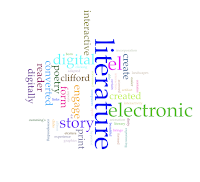
In class, our tribe used two applications to analyze data from three of our previous blog posts including our posts discussing electronic literature , un-creative writing  and Kurzweil .  The first application we used was Voyant , a open-source and web based text analysis tool.  First, we copied the text from all three blog posts and analyzed them three separate times.    When viewing the resulting charts for the electronic literature post, we can see that literature, el (abbreviation for electronic literature), electronic, digital and story were the most frequent/significant words used.  I say significant because short words such as his, her, be or with are not included in this analysis because they are necessary but do not clearly describe the theme of any piece.  After analyzing the results for the uncreative writing blog post we see that thoughts, writing, uncreative, youtube and comment were the most frequently used wo...

Sixth Blog Post: Kurzweil, Singularity and Artificial Intelligence

Image
Technological singularity is a hypothesis that some form of super human or artificial intelligence system will outsmart the best minds or code that one has integrated into it. This technology that we use everyday has a source code scripted into it and collects artificial intelligence to provide you quick computing of your personal doing. The most important general-purpose technology of our era is artificial intelligence, particularly machine learning (ML) — that is, "the machine’s ability to keep improving its performance without humans having to explain exactly how to accomplish all the tasks it’s given." Considering that, Ray Kurzweil has also researched the topic vigorously and is a futurist himself. He has written a book based on his prediction on the singularity, and of the epochs of evolutionary progress, and the potential next epoch being the merger of human technology with human intelligence. However Kurzweil does say that "the evolutionary progress looks ...

The Story of a Punk

Image
My original work of electronic literature takes the form of a self-generating poem. To do this I used Nick Montfort's code from  Taroko Gorge . The code that makes up his webpage is open source, meaning anyone can access and use the code without getting a license. I took advantage of this and copied the code into my own HTML editor and used what I've learned from Digital Humanities to make a version of my own. I used the lyrics of the punk band The Story So Far   to create a self-generating poem called The Story of a Punk . I selected the band's lyrics from their older albums for the generating text. Further, I used their lyrics because of their extensive lyrics that tend to differ from the repetition seen in todays popular genres. To select the proper text for the piece, I dissected each song to find a central phrase or word that would best fit my theme. By selecting certain lines and words from their songs I was able to create a poem that generates in a way that reade...

Original Work of Electronic Literature

Image
I have created a self generating poem. It is a very randomly worded story and is completely vague, the thought behind it was just random events of Joe`s. The words and phrases were all negative and positive and just randomly went with a Joe.I tried to find as many rhyming words as I could to make it significant to my tough pick of story relation. The importance of the poem is that there are many people(joe) in the world that get attached to or achieve different helpful or hurtful things and these are just a couple random vague scenarios through Joe . The text doesn't make sense, but is for the interpreting. Connor K

A Pug's Life

Image
For my piece of electronic literature, I chose to use the program Twine .  I have been developing my CSS and HTML skills using this program in the Digital Tools and Technologies course.  Using Twine for my Digital Humanities course project allowed me to put my abilities to the test.  I was also able to introduce myself to Adobe Photoshop and Adobe Illustrator in converting my sketches into a digital format. My Twine story, A Pug's Life , is about a grey scruffy pug who can't find his human friends.  It is based on a pug I know who is unique and comical.  He is an individualist, yet cares deeply for his owners.  It is a choose your own adventure story which provided me an opportunity to develop my skill set. By: Mary-Lynn

Fifth Blog Post: Group Response to Games

Image
Fifth Blog Post: Do games count? Games are an overlooked piece of interactive literature (or film or art,etc) that can be very useful to interpret or understand an authors message.  Often viewed as entertainment or a leisurely activity, games can actually also be very informative and stimulating to your brain.  The game Ingress , allowed us to interact with the physical world and a virtual world simultaneously.  We believe that games can count as a digital humanity due to the interactive experience that you get from playing a game.  Essentially, you get better at life from experience or training for whatever it is you want to achieve.  That theory coincides with the gaming world in a sense that you are faced with a task and you must do whatever you know or are taught to do to complete that task.  More than likely people go through a game and lose a level once or twice and are forced to restart it, however they already have knowledge of that level (or wha...